
by William Wise; illus. by Winifred Lubell
Rand McNally & Company, 1969

My copy is missing its jacket. So here’s a look at the title page, so you can get a feel for the illustration:
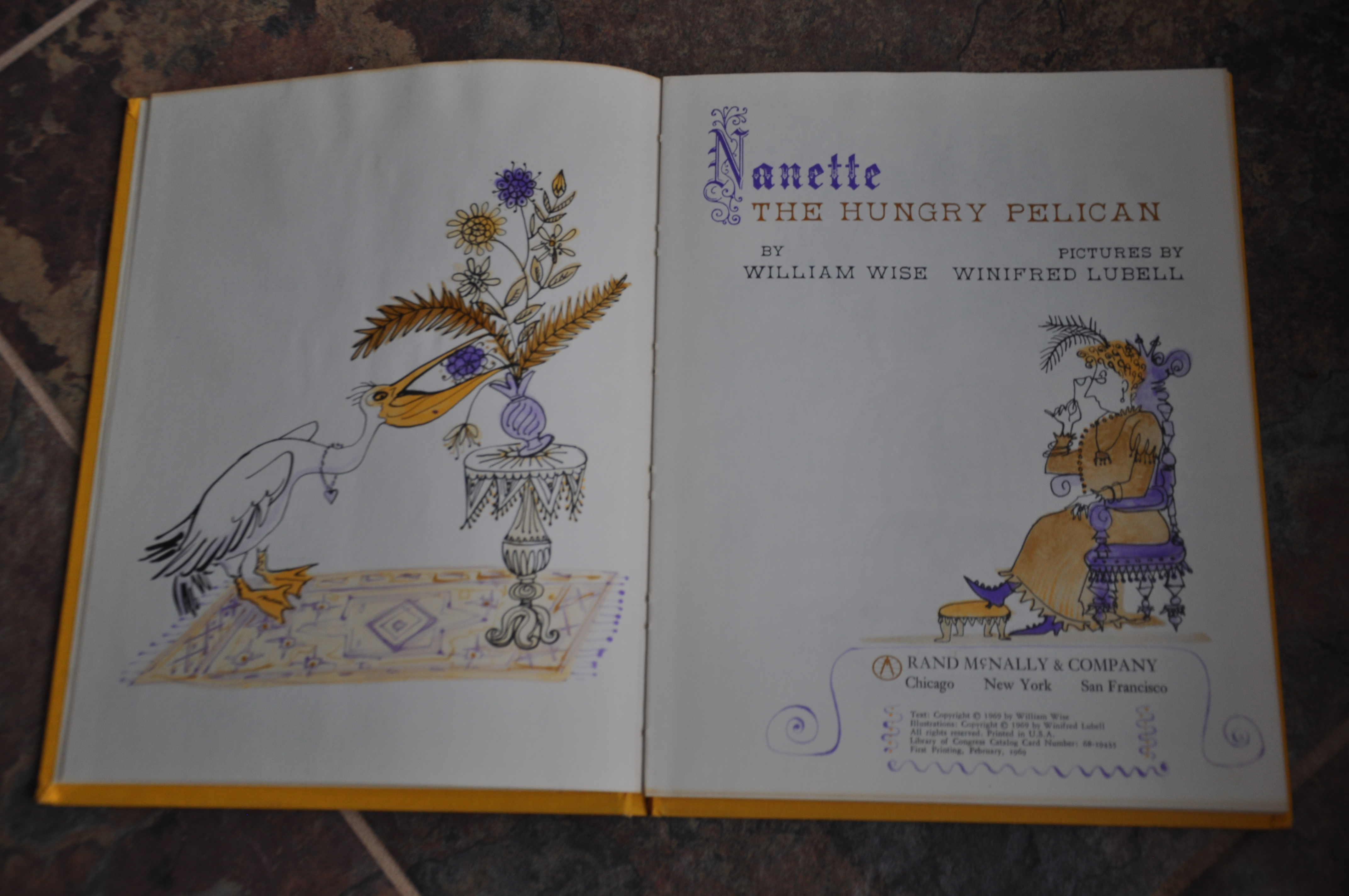
I love this aesthetic. And pelicans are my favorite birds (maybe my favorite animals? but that’s a big comittment).
Funny that I picked Nanette just after Rickety Racket Rooster. They have quite a bit in common: both feature an incorrigible bird that eventually saves the day, both published late 60s, both have line illustrations with two color washes*, and (and this is a small detail, but I noticed) both have a piece of art that reacts to the story. Oh, also ROBBERS! My, to have lived in the 60s.
But where Rickety Rackety suffers from a severe case of verbosity, Nanette is absolutely charming in its spare, rhyming story. The rhyme scheme is AABCCB, which the Internet tells me can be called Spanish Sestets.
The plot: Mrs. Peabody Fitch is a very rich (suspected) widow who lives alone (with her staff) in a house the size of a mountain.
“Because she was rich
Mrs. Peabody Fitch
Liked to live in a dignified way.
She did not care for noise,
Children’s pets, or rude boys,
Or for any unseemly display.”

I want to be Mrs. Peabody Fitch
But her niece (Bernice) comes to visit and her pet pelican, Nanette, disrupts Mrs. Peabody Fitch’s mountain-house serenity by eating almost everything she sees. Fish, at first, then on to basically all of the food in the house and even flowers, hoses, and laundry. (Pelicans are pretty voracious but as far as I know confine their diet to marine life.) Mrs. Peabody Fitch is having none of it and sentences Nanette to Be Gone Forever as of tomorrow. That night, some robbers sneak in to the big house and Nanette happens to be awake because she is ill from all the crap she’s eaten. She saves the day by scaring away the thieves and saving the stolen jewels in her beak. All is forgiven, and Nanette is served everything she could possibly want to eat (including flowers, hoses, laundry, and “a bottle of pills for her tummy”).

reconciliation, as animated bust looks on in approval
I find some books take rhyming to overkill but I never felt that way with this one. I also take issue with books that rhyme but fight the meter, and this one doesn’t (those books are awfully hard to read aloud, which is kind of the point of rhyming picture books). The yellow and purple washes really work for the regal elegance of Mrs. Peabody Fitch, her extravagant lifestyle, and even Nanette. The whole thing is utterly charming and I just love it.
*I would love to be a Picture Book Historian. I am sure there are financial or other underlying reasons for this style of illustration, but it may take some investigating. Not all books in the 60s look like this… The Snowy Day was first published in 1962, Where the Wild Things Are in ’63, and The Very Hungry Caterpillar in 1969, the same year as this book.
 Angela Barratt