
by Jan Wahl; illus. by John E. Johnson
Simon & Schuster, 1968
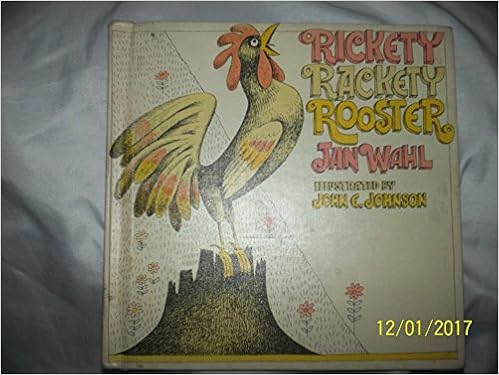
image from Amazon
Google books describes it this way: “A rooster, with a piercing crow, crows on for years before anyone stops to see what all the noise is about.”
Literally years, which is kind of how long this book takes. The plot is seriously bizarre, with several odd non-sequiturs. For instance, the horse is too busy talking about how to shut Rickety Rackety up that he crashes into the neighbor’s house… Actually, now that I think about it all of the seeming non-sequiturs are about how steep the hill is. I suppose the book is just juggling too many plot points here, and it gets a little unwieldy. Since you are almost definitely never going to encounter this book, I can go ahead and spoil it for you: Rickety Rackety lives with his owners, Farmer and Mrs.Puckle, on the top of a steep hill that was once inhabited by robbers. Rickety Rackety sits on a stump and crows ceaselessly. At the bottom of the hill lives their evil neighbor Farmer Cronk, who collects all of the fruit and vegetables that roll down from the Puckle’s farm and sells them at the market alongside his own (this makes him a smug, rich bastard: ). Everyone at the farm has an idea about how to silence Rickety Rackety, but no one takes initiative and they just let him keep crowing all the damn time. Here was my favorite: “‘We could pull him in the water,’ the ducks cried. ‘Then he wouldn’t have any breath left to crow with.” Sinister, no? Then there’s the long exposition of the crops rolling down the hill and Rickety Rackety still racketing, and I thought aha! here is where our plots intersect! I was wrong. There is a big buildup that leads to Farmer Puckle doing nothing. After many years of enduring sleepless nights and stressful days, Farmer Puckle finally gets angry (“turnips and tarnation!”) and decides to have a nice chicken dinner puts a bushel over R.R.’s head. Puckle is close enough to the stump that he notices what R.R. has been trying to show him all these years: there’s gold buried under the stump, leftovers from the days the robbers inhabited the farm (“haHA! I bet you didn’t remember when I said ROBBERS had lived here, before!” -Jan Wahl. And honestly, no, I didn’t, because there were so many words in between). So Rickety Rackety finally calms down, they level the hill so that evil Cronk doesn’t make off with their hard-earned produce, and everyone lives happily ever after. Except Rickety Rackety, because the Puckles put up this really unnecessary sign: “CROWING ONLY WHEN NECESSARY & MON. THROUGH FRI. AT NOON.” Yes, it was in all caps.
The illustrations were truly quite amusing sometimes, but the drab color palette made them feel pretty lifeless. I mean, R.R. is described as having “wide green shiny wings,” but as you can see from the cover he is mostly just on the yellow side of beige. I think this was common back when groovy monochromatics were in vogue, but I know that many books from this era were printed in brilliant color (so at least some people knew what was what).
Things I like about this book:
–buried treasure!
–the smell. It smells exactly like the books my dad had as a kid, because it is exactly as old as the books my dad had as a kid. (Anyone ever read There’s an Elephant in the Bathtub? Because that shizz is my favorite of my dad’s old books.)
–in one of the illustrations, a painting hung on the wall is plugging it’s ears along with the Puckles
–all of the animals who hate listening to Rickety Rackety pretty much just look drunk
exhibit A:

those ducks have murder in their drunk little eyes
…and that’s pretty much it.
 Angela Barratt